Furniture and equipment purchasing for a hospitality project spans many product types, vendors, rooms, and installation dates. Coordination begins with a controlled item schedule that links each product to its specification, finish, quantity, approved sample, supplier, and delivery phase. Buyers can then compare offers on the same basis, manage interfaces between products, and resolve changes before they disrupt production or room handover.
Key takeaways
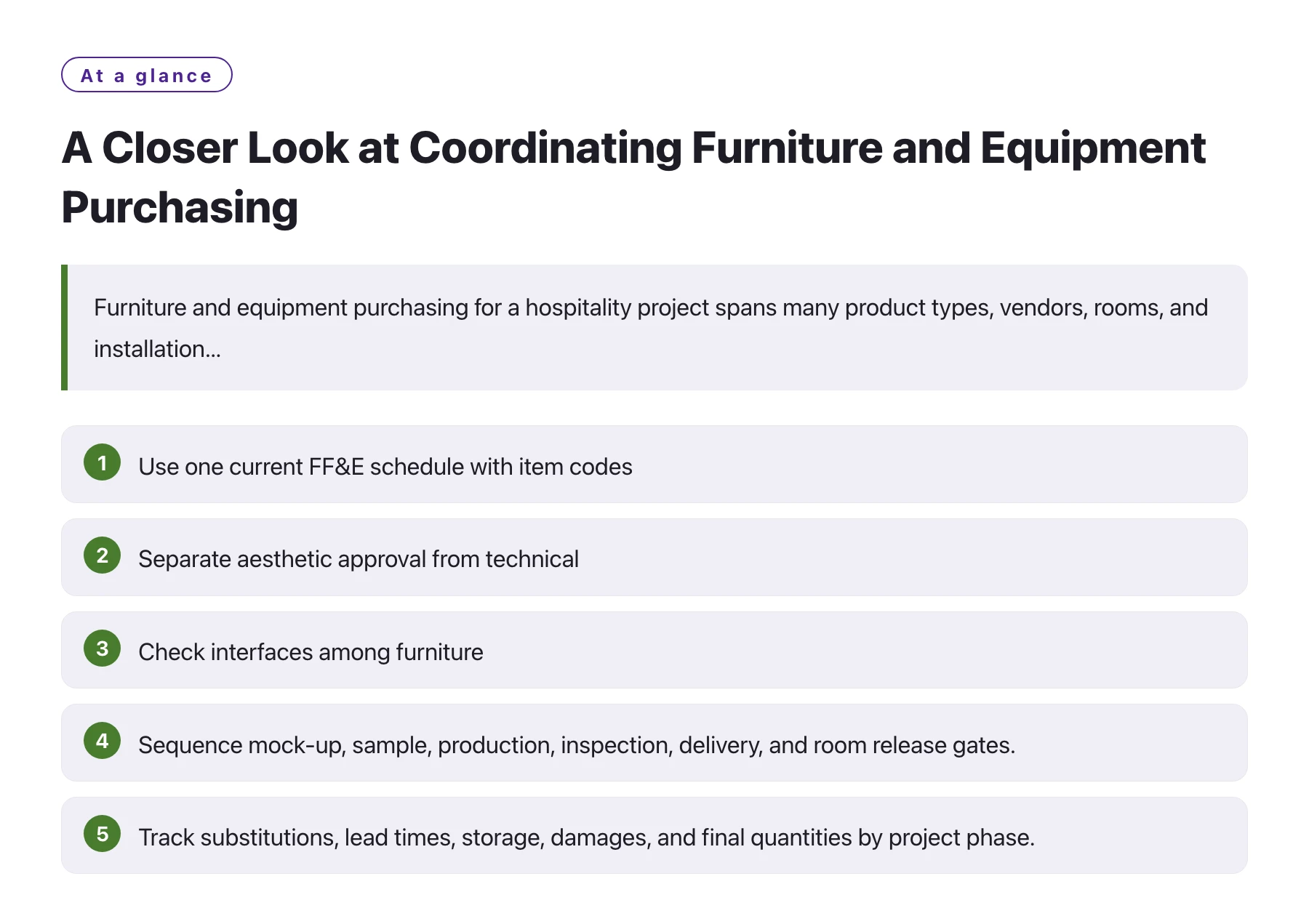
- Use one current FF&E schedule with item codes, locations, quantities, and revisions.
- Separate aesthetic approval from technical, safety, compliance, and commercial approval.
- Check interfaces among furniture, equipment, power, plumbing, dimensions, and installation.
- Sequence mock-up, sample, production, inspection, delivery, and room release gates.
- Track substitutions, lead times, storage, damages, and final quantities by project phase.
A shared schedule creates one map from design intent to procurement, site delivery, and installation.
1. Build a room-based purchasing schedule
List every furniture and equipment item by unique code, room or zone, quantity, description, dimensions, finish, supplier, required-on-site date, and specification revision. Link the item to drawings, finish schedules, approved samples, and purchase orders. Group duplicate items where appropriate, but retain the locations and quantities needed for phased delivery, replenishment, and defect tracking.
Designate a schedule owner and define how revisions are issued. Mark deleted, replaced, and pending items clearly so an old spreadsheet cannot silently become a purchasing instruction. Record allowances and provisional quantities separately from approved orders. If a room layout changes, identify which items, power connections, access routes, or installation assumptions may also change.
2. Define the specification and decision rights
For each item, separate mandatory dimensions, materials, performance, finish, fire or safety evidence where applicable, maintenance needs, and visual preferences. Identify who approves design intent, technical compliance, price, and final sample. A finish sign-off should not automatically approve dimensions or performance. Confirm destination market, intended use, and project codes before asking suppliers for compliance documents.
Use a responsibility matrix for designer, operator, procurement, engineering, quality, and supplier. State who may accept substitutions and which changes require a new sample, quotation, or test. For lounge seating in public spaces, the relevant ANSI/BIFMA X5.4-2020(R2025) standard covers public and lounge seating; confirm its fit with the actual item and project specification rather than applying it to unrelated furniture or equipment. [1]
3. Coordinate product interfaces
Furniture and equipment can depend on adjacent trades and site conditions. Check clearances, door widths, lift access, anchoring points, power and data connections, plumbing, ventilation, service access, and cleaning routes where relevant. Confirm who supplies connectors, brackets, cables, cut-outs, and installation hardware. Record assumptions in drawings and purchase documents so vendors do not design to different room measurements.
Arrange a mock-up or sample room when multiple products must work together visually or functionally. Include representative finishes, lighting, dimensions, and installed interfaces. Capture decisions with reference photos, approved drawings, and sign-off names. If the mock-up identifies a conflict, list affected item codes and obtain revised quotations or production drawings before releasing related orders.
4. Compare suppliers and quotations consistently
Issue the same item list, technical requirements, quantity, delivery phase, packing expectations, and quote deadline to each candidate. Compare unit price, tooling, packaging, testing, spares, warranty, installation support, lead time, payment, and exclusions in a line-by-line matrix. Separate local delivery, international freight, storage, customs, and last-mile responsibilities. Different Incoterms, packaging assumptions, or quote currencies can otherwise make totals misleading.
Ask suppliers to identify long-lead components, capacity constraints, alternate materials, and validity periods. Preserve written clarifications beside each quotation. If a vendor combines several categories, retain the line-level basis so a change to one item does not obscure the cost or delivery impact on others. Track any commission or service fee separately from the product price.
5. Control samples, mock-ups, and substitutions
Log each sample by item code, supplier, material, finish, revision, date, and decision status. State whether it represents production materials and workmanship, and list anything still provisional. Photograph samples under agreed lighting and keep retained references protected from damage. For repeat units, define acceptable variation and who compares incoming production against the approved benchmark.
Require written change requests for an unavailable finish, revised dimension, alternate factory, or component substitution. The request should describe reason, evidence, price, timing, warranty, maintenance, and effect on interfaces. The buyer’s authorized design or technical owner should decide before production changes. A verbal site conversation can flag an issue, but it should not replace an updated schedule and approval record.
6. Plan production, inspection, and delivery phases
Create milestones for drawing approval, sample approval, production start, in-process checks where risk warrants them, finished inspection, packing, dispatch, site receiving, and installation. Link each milestone to an owner and evidence requirement. Check that procurement dates leave time for rework, shipping, customs, site storage, and installation. Keep items needed for early room mock-ups distinct from later bulk phases.
Use a delivery matrix with item codes, quantities, delivery phase, destination, access constraints, and storage instructions. Coordinate with the site team about receiving hours, unloading, lift capacity, floor protection, and secure storage. If construction readiness is uncertain, agree how goods will be held, insured, and protected from humidity, dust, or damage before authorizing early delivery.
7. Inspect, receive, and close the record
Before dispatch, check the agreed product features, finish, dimensions, accessories, packaging, labels, and required documents. At receiving, reconcile cartons and items against the delivery matrix and record visible damage, shortages, or wrong-room deliveries. Link photos and inspection notes to item code, batch, and shipment. Do not sign a clean receipt if the record should note an exception or quantity variance.
Define disposition for damaged or nonconforming items: repair, replacement, credit, rework, or conditional use. Name the person who approves and track promised dates against room handover. Close each line only when delivery, installation, documents, punch-list items, and warranty information are complete. This gives operations a usable asset record after the procurement team has moved to the next phase.
8. Review the purchasing process after handover
Compare the original schedule with actual lead times, changes, freight, storage, damage, missing parts, installation effort, and accepted substitutions. Identify which delays came from design decisions, supplier constraints, site readiness, or logistics handoffs. Use that evidence to improve the next project’s specification templates, approval gates, and vendor briefing.
Keep lessons specific to item, supplier, site, and project phase. A good outcome for one chair, casework line, or appliance does not prove every category will perform the same way. Buyers arranging hospitality FF&E procurement can coordinate several vendors through a shared item schedule while retaining product-specific approvals and technical reviews.
Sources
Frequently asked questions
What does FF&E purchasing coordination need to track?
Track item codes, room locations, quantities, specifications, approvals, suppliers, prices, production milestones, delivery phases, inspection evidence, changes, and installation or closeout status.
Who should approve a furniture substitution?
Use the project’s responsibility matrix. The authorized design or technical owner should assess fit and performance, while procurement records price and schedule effects before purchase approval.
When is a sample room useful?
Use one when products, finishes, lighting, dimensions, or trade interfaces need to be evaluated together. Record the mock-up scope, approved references, open issues, and responsible signatories.
How can phased deliveries be controlled?
Assign each item and quantity to a delivery phase, destination, access plan, and receiving owner. Reconcile shipment documents and site counts, and track exceptions by item and room.