Exclusivity is usually discussed as a single yes-or-no question and written as four or five clauses that have to agree with each other. Formula exclusivity, category limits, territory, term length and minimum volume commitments are separate levers, and a deal that pulls one of them without adjusting the others tends to produce a disagreement later. This is a commercial-terms discussion rather than legal advice, but the questions are worth settling before signature.
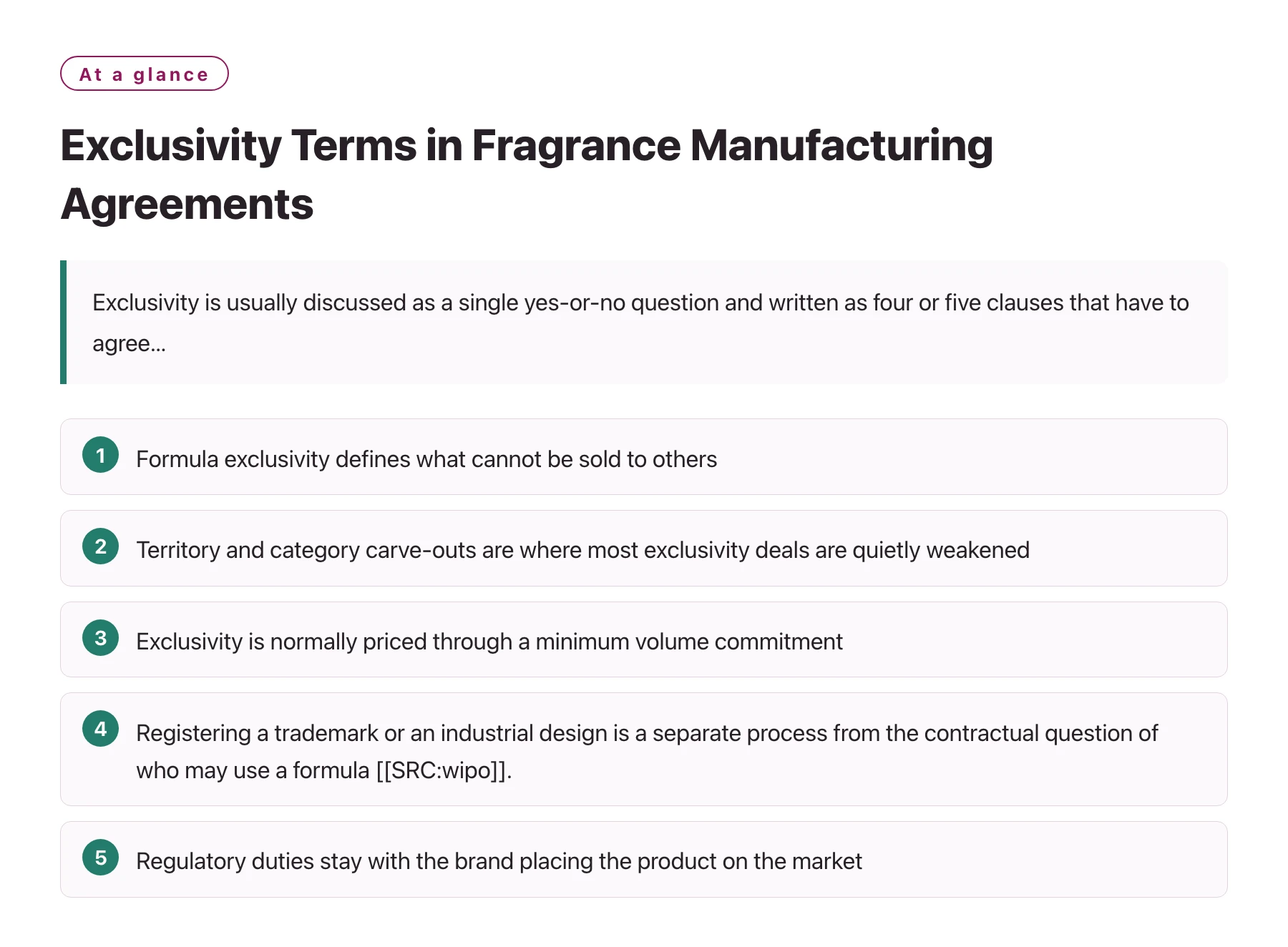
Key takeawaysFormula exclusivity defines what cannot be sold to others, so it has to state whether the limit covers the exact formula, the accord or the whole product concept. · Territory and category carve-outs are where most exclusivity deals are quietly weakened, because a formula can be exclusive in one market and shared in another. · Exclusivity is normally priced through a minimum volume commitment, so the commercial cost appears as an obligation rather than as a fee. · Registering a trademark or an industrial design is a separate process from the contractual question of who may use a formula [1]. · Regulatory duties stay with the brand placing the product on the market, which in the European Union means the responsible person requirement applies regardless of who developed the formula [2].
The request is familiar: the brand wants the product to be its own, and the manufacturer wants a return on the development work. Exclusivity is the mechanism that reconciles the two, and it is almost always described in a single sentence before it is written as a set of clauses.
That gap is where disputes live. An offer of exclusivity can be genuine, generous and still leave the brand exposed, because the clause that grants it and the clause that defines its limits may not describe the same thing.
This article breaks the arrangement into its parts, sets out what each part buys and costs, and looks at the period after the term ends — the part of the contract that most projects overlook.
Reading an exclusivity offer term by term
- Identify what is actually exclusiveAsk whether the commitment covers the exact formula, the key accord, the product concept or merely the artwork, because the four are very different promises.
- Map the territoryEstablish whether exclusivity applies worldwide, by region or by country, and whether online sales into an excluded market count as a breach.
- Map the categoryA formula can be exclusive in fine fragrance and available in home care, so list the product categories the limit covers.
- Fix the term and the renewal routeState the duration, what happens at renewal and whether either side can decline to renew without penalty.
- Quantify the volume commitmentExclusivity is usually paid for with minimum volumes, so confirm the threshold, the measurement period and the consequence of missing it.
- Agree the exit before the entryDecide what transfers on termination, what the notice period is and whether the manufacturer may sell the formula after it ends.
What exclusivity covers, and what it quietly leaves out
Exclusivity is a restriction on the manufacturer's behaviour, not a transfer of ownership. That distinction explains most of the disappointment that follows an arrangement that looked clear at the time.
Two gaps account for most of it.
Formula exclusivity is narrower than it sounds
A house can reasonably promise that your exact formula will not be sold to another client, and still offer a very similar composition to a brand in a different market, because the two formulas are not identical.
If sameness matters to you, define it. A clause that sets a measurable definition of similarity, or that names the signature accord rather than the complete formula, is far more protective than a general promise of exclusivity.
Territory and category carve-outs
Many offers are exclusive by territory rather than globally, which is often a fair arrangement and always worth reading carefully. The awkward cases are cross-border online sales and travel retail, where a product sold from one market reaches customers in another.
Categories work the same way. A formula developed for an eau de parfum may also appear in a candle or a body product, which is usually outside the scope of what the brand believed it had secured.
The clause most often signed without discussion is the volume commitment, and it is the one that has real money attached. Exclusivity restricts what a manufacturer can sell, so the brand is normally asked to guarantee a minimum. Read that number against your realistic forecast rather than your optimistic one, and check the definition of the measurement period, whether shortfalls can be topped up, and what remedy the manufacturer holds if you miss. A minimum volume that is comfortable on paper and unreachable in practice converts an exclusivity agreement into a penalty.
Common clauses and what each one actually buys
| Clause | What it protects | What it usually costs the brand |
|---|---|---|
| Formula exclusivity | The specific composition and its documentation | A higher development fee or a dedicated development commitment |
| Category exclusivity | Named product types, such as fine fragrance only | A narrower commitment from the manufacturer and a lower fee |
| Territory exclusivity | Named markets, with cross-border sales defined | Minimum volumes per territory and reporting obligations |
| Term and renewal | The period during which the arrangement holds | A longer commitment than the product may need |
| Minimum volume | The manufacturer's return on the development work | A financial obligation that continues even if sales slow |
| Post-term restriction | A period after termination during which the formula stays off the market | Continuity risk if you need to redevelop with another partner |
No single row is unfair on its own, and the combination is what determines whether the deal is balanced. Three narrow exclusivity limits plus a large volume commitment is a demanding contract; one broad limit plus a modest commitment is generous. Read the rows together rather than one at a time.
Planning for the end of the term
Exclusivity agreements are written at the beginning of a relationship and tested at the end of one. The clauses that matter most are the ones nobody reads until the product has become valuable.
Two of them deserve attention at signature rather than at renewal.
Tail periods and reversion
A tail period prevents the manufacturer from selling the formula for a defined time after the agreement ends. It is reasonable, and it also means you cannot simply redevelop elsewhere and launch immediately without checking the wording.
Ask what happens to retained samples, bulk stock and packaging components at termination, and whether you may buy remaining stock. Those practical questions decide how orderly the transition is.
When exclusivity is the wrong tool
If the product is early, unproven or seasonal, exclusivity may cost more than it protects. A time-limited agreement, or exclusivity restricted to one territory while the product is tested, keeps the manufacturer's incentive intact without committing the brand to volumes it cannot forecast.
Registration of the brand marks is a separate matter again. Trademarks and industrial designs are registered through the intellectual property system, which is independent of the contract that governs formula use [1].
Regulatory responsibility follows the product rather than the agreement. In the European Union, the responsible person requirement attaches to the product placed on the market, so exclusivity does not shift that duty to the manufacturer [2].
Manufacturers that offer exclusivity usually combine all of these limits into one paragraph, and it is worth unpacking that paragraph before signing. When an offer from a company such as Xuelei Cosmetics arrives, ask for the formula, category, territory and term limits to be listed separately, so each one can be weighed on its own.
Sources
- WIPO — World Intellectual Property Organization —— The UN agency for intellectual property; resources on industrial design and patent protection relevant to product and packaging design.
- European Commission: Cosmetics in the EU —— The European Commission's overview of EU cosmetics rules, including the responsible person, product information file and safety report requirements.
Frequently asked questions
What does formula exclusivity usually mean in practice?
It normally means the manufacturer will not sell your specific formula to another client. It does not prevent a similar composition from being offered elsewhere, so if similarity matters, the clause should define what counts as the same formula or name the signature accord that must be reserved.
Is exclusivity included in the price of development?
Rarely in full. Because exclusivity restricts what the manufacturer can sell, the cost usually appears as a minimum volume commitment rather than a fee. Compare the commitment against a realistic forecast, and check the measurement period and the remedy if you fall short.
Can I get exclusivity in one market only?
Yes, and it is a common arrangement. Territory-limited exclusivity usually costs less and suits a brand testing one market. Confirm how cross-border online sales and travel retail are treated, because those channels can carry your product into markets you believed were excluded.
What happens to the formula when the agreement ends?
It depends entirely on the post-term clause. Some agreements keep the formula off the market for a defined tail period; others allow the manufacturer to reuse it immediately. Ask what transfers to you, what happens to retained samples and remaining components, and how much notice is required.
Does exclusivity transfer regulatory responsibility to the manufacturer?
No. Regulatory duties follow the product placed on the market, not the development contract. In the European Union the responsible person must be established in the Union, and that obligation sits with the brand side of the arrangement regardless of who owns or developed the formula.