A First Rig, a Written Guide, and the Numbers to Check Before Powering Up
A first ASIC usually arrives with two documents open on the desk: the seller's spec sheet and some kind of mining guide. The arithmetic in the middle is short. At 457 TH/s the pool credits 0.00020501 BTC a day before fees, which is $17.36 at $84,692 per BTC, and $16.67 once the listed 4% on the block-reward component is taken out. A guide is useful when it lets you rebuild that figure yourself.
Key takeaways
- The whole network issues 450 BTC a day, so a rig's share is its hashrate divided by roughly 1,003 EH/s.
- 457 TH/s works out to 0.00020501 BTC a day, or $17.36 at $84,692, before any fee.
- The listed 4% applies to the block-reward part only; the fee part carries 2%, so net is not gross minus 6%.
- Difficulty was 132.76 T on 21 Sept 2026 with a next-adjustment estimate of −2.12%, which is a snapshot and not a trend.
What the spec sheet leaves out
A spec sheet lists watts, joules per terahash, fan noise and the size of the box. It says nothing about earnings, because earnings depend on three things the seller does not set: the network total, the block subsidy and the price a buyer will pay for the coin. Listing pages age within weeks. A guide that shows its inputs stays usable for as long as you are willing to redo the sum.
That is the real difference between a screenshot and a method. A screenshot gives you a number with no handle on it. A method gives you three numbers you can look up on a Tuesday afternoon and a division you can do in a spreadsheet. When the network total moves, the method still works and the screenshot is decoration.
One more omission matters before the first power-up: the spec sheet quotes a nameplate hashrate at a stated ambient temperature and a stated power mode. Run the same box in a hot room on a lower power profile and the number you feed into the formula is smaller. Use the figure your dashboard actually reports after a day of running, not the one printed on the carton.
The one formula worth memorising
Your hashrate divided by the network hashrate, times 450 BTC, gives gross daily output. The 450 comes from 144 blocks a day at 3.125 BTC each. At the 21 Sept 2026 reading the network ran at about 1,003 EH/s against difficulty of 132.76 T, so the per-terahash daily rate was 0.0000004486 BTC.
A ViaBTC Mining Guide is a sensible place to see that formula written next to the account features it belongs with: the two payout schemes, the wallet, the calculator, the app. Read it as a map of what the account can do. Then redo the division yourself, because the sum has three inputs and no hidden fourth.
Where the listed four percent lands
PPS+ is the default scheme. The listed 4% is charged on the PPS-settled block reward, while the transaction-fee component is distributed on PPLNS logic with a listed 2% rate. Two rates on two components. A miner who subtracts 6% from gross gets a number that is close by accident and a model that is wrong on purpose.
The alternative is PPLNS, listed at 2% on the block reward and fees combined, settled after six confirmations and shared across the last five difficulty rounds. PPS+ settles hourly against current difficulty and keeps pool luck out of the miner's result. Choosing between them is a question about variance and timing, not about which headline number is smaller.
Three tiers, checked against the chart
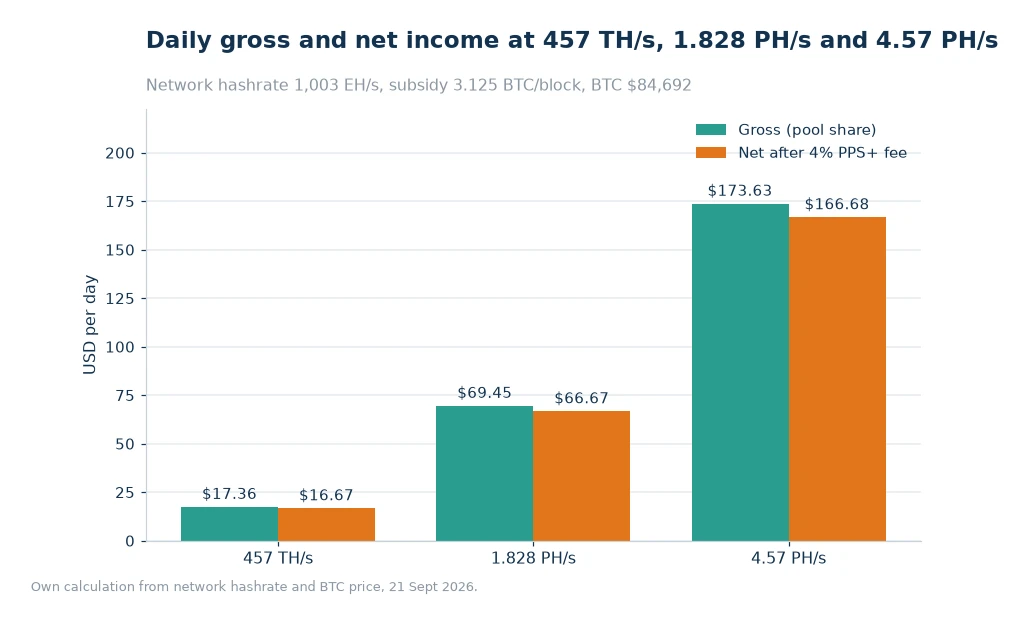
The chart behind this article uses three sizes: a single mid-size machine at 457 TH/s, a small cluster at 1.828 PH/s and a container-scale share at 4.57 PH/s. The table repeats the same values in a form you can compare against a power bill, with the fee shown as a dollar amount rather than a percentage.
| Hashrate | BTC per day, gross | USD per day, gross | USD per day, net |
|---|---|---|---|
| 457 TH/s | 0.00020501 | $17.36 | $16.67 |
| 1.828 PH/s | 0.00082005 | $69.45 | $66.67 |
| 4.57 PH/s | 0.00205013 | $173.63 | $166.68 |
Worked example
Start with the per-terahash rate and build upward; every figure below rounds to the chart. Nothing in this list is specific to a brand or a model, which is why it travels: swap the hashrate and the same five lines describe a different machine.
- 450 BTC ÷ 1,003,000,000 TH/s = 0.0000004486 BTC per TH/s per day.
- At 457 TH/s: 457 × 0.0000004486 = 0.00020501 BTC.
- In dollars: 0.00020501 × 84,692 = $17.36.
- Fee on the block-reward part: 4% of $17.36 is $0.69, leaving $16.67. The small gap to the fee component explains the cent.
- At 1.828 PH/s, which is 1,828 TH/s: 1,828 × 0.0000004486 = 0.00082005 BTC, or $69.45; four-fifths of a dollar comes off, leaving $66.67.
- At 4.57 PH/s, which is 4,570 TH/s: 4,570 × 0.0000004486 = 0.00205013 BTC, or $173.63; net $166.68.
The multiplier between tiers is exactly ten, and the outputs scale with it. That is the property to test a guide against. If a table's rows do not scale with hashrate, something else is baked into the numbers — usually an assumed uptime or an unstated fee.
Questions the guide cannot answer
Three inputs sit outside the pool's arithmetic and inside your own situation. The first is the price you pay per kilowatt-hour, including every add-on on the bill. The second is uptime: a rig that runs 92% of the month earns 92% of the figures above, and a guide has no way to know your heat, your breaker or your internet. The third is what the hardware is worth when you stop using it.
A fourth question is harder still: how long the current subsidy and network total last. Nobody can answer that with a table. What a reader can do is bracket it. Run the sum at today's inputs, then run it again with the network total 20% higher and see whether the answer still clears your power cost. If it does not, the guide has done its job by showing you early.
Frequently asked questions
Is 457 TH/s enough to earn every day?
Under PPS+ it is, because payment follows shares rather than solved blocks: 457 TH/s credits about 0.00020501 BTC a day, settled hourly against current difficulty, so there is no waiting for a lucky block.
Why is the net figure not gross minus six percent?
The listed 4% is charged on the PPS-settled block reward and the listed 2% on the transaction-fee component, which is a much smaller slice of the payment, so subtracting 6% from gross overstates the deduction.
Do I need to pick a payout scheme before mining?
PPS+ is the default and suits a miner who wants steady hourly credits; PPLNS is the alternative at a listed 2% on combined reward and fees, paid after six confirmations, and suits a miner who can absorb variance.
Put the sum on one page
Write three lines on a sheet: your hashrate, the network total you read today, and the price of BTC. Do the division, then subtract your power cost per day. Keep the sheet and add a new row each month. After three rows you will know more about your own operation than any article can tell you, because the numbers will be yours.
For the dollar conversion at your exact hashrate, the Profit Calculator takes the price, difficulty, fee rate and effective hashrate and returns a daily estimate. The fee schedule is where the 4% and 2% are written down, and it is worth reading the component labels rather than the headline percentages.
Sources: ViaBTC homepage, fee schedule and calculator pages for scheme definitions and the listed rates; chain inputs read 21 Sept 2026 — network hashrate about 1,003 EH/s, difficulty 132.76 T, 3.125 BTC per block, 144 blocks a day, BTC $84,692. Published 24 Oct 2026. Figures assume continuous uptime and are arithmetic on the inputs above[1].